
Is Your Makeup Toxic? The Alarming Rise of PFAS in Cosmetics
Your 'beauty haul' might look harmless, but watch out - the cosmetics you're bringing home might contain 'forever chemicals' that pose serious health risks, according to researchers.

STORY AT-A-GLANCE
A review by the U.S. Food and Drug Administration (FDA) identified 51 PFAS in 1,744 cosmetic products. Among the 25 most-used PFAS, 19 lacked sufficient safety data for assessment
The most common PFAS in European makeup were polytetrafluoroethylene (PTFE) in 26% of PFAS-positive products and perfluorodecalin in 22%, both used to soften skin
In a 2021 study, researchers discovered that 82% of waterproof mascaras and over 60% of tested lipsticks and foundations contained high levels of fluorine, indicating the presence of hidden PFAS
Several top brands like Urban Decay, Inglot, L’Oréal, Maybelline, Burt’s Bees, and Bare Minerals have faced lawsuits or investigations for PFAS contamination despite being marketed as “natural” or “clean”
While the FDA lacks a national ban, U.S. states are now leading the shift toward PFAS-free beauty products — nine states have passed or scheduled bans on intentionally added PFAS in cosmetics through 2032

If you love discovering the next best mascara or a foundation that truly lasts, you’re not alone. Beauty is fun, and it’s normal to want products that perform — smudge-proof, waterproof, shine-free. What often goes unnoticed is how those results are achieved. According to CNN1 and The Guardian,2 many long-wear cosmetics rely on per- and polyfluoroalkyl substances (PFAS), or what’s called “forever chemicals,” to improve texture, increase water resistance, and help makeup cling to skin.
These manmade compounds also appear in everyday items like fabrics and cookware,3 which is why they’re hard to avoid. They don’t break down in the body or the environment. Instead, they build up over time, so even “trace” exposures can have long-term effects. What was once seen as just an environmental problem is now known as a global public health crisis.
Studies show that nearly 97% of Americans now have PFAS in their blood,4 and exposure has been linked to a long list of health issues, including reduced fertility and pregnancy complications, developmental delays and low birth weight, increased risk of cancers, immune suppression, thyroid and hormonal disruption, elevated cholesterol and metabolic disorders, and fatty liver disease driven by chronic inflammation and oxidative stress.5
PFAS in Cosmetics Raise Safety Questions
A federally mandated review by the U.S. Food and Drug Administration (FDA) under the Modernization of Cosmetics Regulation Act of 2022 (MoCRA) focuses on PFAS added to cosmetic products rather than being painted as a pollutant.6 The FDA analyzed 1,744 cosmetic products and identified 51 PFAS chemicals, then zeroed in on the 25 most frequently used compounds, which account for about 96% of PFAS found in cosmetics.7
Only a few chemicals could be checked for safety — According to the agency, many toxicology data are incomplete or not readily available for independent review. As a result, they could not determine the safety of most PFAS used in cosmetics. Of the 25 chemicals they were able to evaluate, five were classified as having low safety concerns, while one was flagged for possible health risks. FDA Commissioner Marty Makary, M.D., M.P.H., said:8 9
“Our scientists found that toxicological data for most PFAS are incomplete or unavailable, leaving significant uncertainty about consumer safety. This lack of reliable data demands further research. Consistent with the MAHA Strategy Report, the FDA will continue working with the CDC and EPA to update and strengthen recommendations on PFAS across the retail and food supply chain.”
Common PFAS ingredients found in cosmetics — The FDA found the following chemicals in the cosmetics they tested:10
Polytetrafluoroethylene (PTFE)
Perfluorononyl dimethicone
Perfluorohexylethyl triethoxysilane
Trifluoroacetyl tripeptide-2
Tetradecyl aminobutyroylvalylaminobutyric urea trifluoroacetate
Methyl perfluorobutyl ether
Methyl perfluoroisobutyl ether
No federal ban exists yet — Under existing enforcement policies, the FDA may take enforcement action if specific products are proven dangerous, but there are currently no existing U.S. laws that ban PFAS in cosmetics to prevent exposure upfront. Looking ahead, the FDA stated it will continue monitoring new scientific evidence and invest more resources into closing major data gaps.11
While the FDA continues to review PFAS safety, individual states are taking action independently. Several have already implemented bans or restrictions, and more are on the way.
Which States Are Taking Action Against PFAS in Cosmetics?
The FDA’s 2025 report made one thing clear: There are still major gaps in safety data for PFAS in cosmetics. But while the federal government is still evaluating risks, several U.S. states aren’t waiting. Over the past two years, a growing number of states have passed laws to ban or restrict intentionally added PFAS in cosmetic and personal care products. These laws vary in scope, but together they reflect a sweeping shift:12
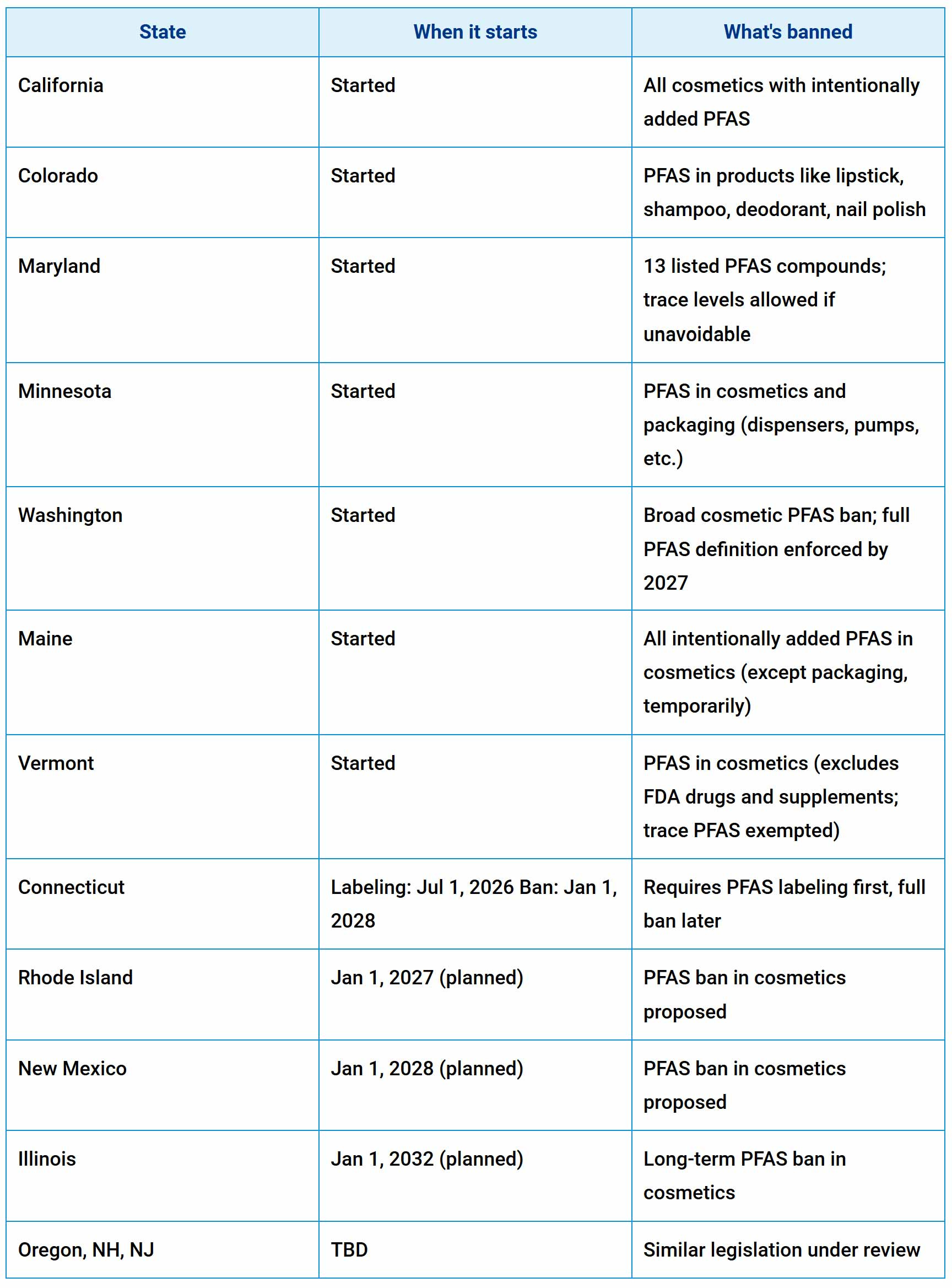
States with current bans — As of January 1, 2025, five states enacted some of the first cosmetic-specific PFAS bans in the country:
California (AB 2771, PFAS-Free Cosmetics Act) — Prohibits manufacturing, selling, or distributing any cosmetic with intentionally added PFAS.
Colorado (HB 22-1345) — Bans sale or distribution of cosmetics with intentionally added PFAS, including products like shampoo, lipsticks, and nail polish.
Maryland (HB 643) — Outlaws cosmetics with 13 specified PFAS types, allowing only trace amounts that are technically unavoidable.
Minnesota (HF 2310, “Amara’s Law”) — Prohibits sale or distribution of cosmetics with intentionally added PFAS.
Washington (HB/SB 1047) — Makes it illegal to manufacture or sell cosmetics containing intentionally added PFAS, including foundation, waterproof mascara, and deodorant.
States with upcoming bans in 2026 — Three states have implemented or will implement PFAS restrictions this year, often using phased or hybrid approaches that include labeling, reporting, and eventual bans. These are:
Connecticut (Public Act 24-59 / SB 292) — Starting July 1, 2026, manufacturers must label PFAS-containing cosmetics and notify the state; full ban begins January 1, 2028.
Maine (LD 1537) — Effective January 1, 2026, bans cosmetics with intentionally added PFAS, except those sold in fluorinated packaging.
Vermont (SB 25) — Effective January 1, 2026, prohibits cosmetics with intentionally added PFAS, with exceptions for trace contamination.
States like New Hampshire, New Jersey, Oregon, and Rhode Island (2027), New Mexico (2028), and Illinois (2032) are planning similar restrictions. New York is also considering legislation.
The table below summarizes key state actions, including when restrictions begin and which types of products are affected:
You might think this is just an issue in the U.S., but PFAS know no borders. As beauty brands pursue waterproof, long-lasting, high-performance formulas, these chemicals have quietly become a global concern. Europe, too, faces its own PFAS problems.
Forever Chemicals Are in European Cosmetics, Too
A 2024 study published in Food and Chemical Toxicology13 examined 765 cosmetic products sold across Europe, analyzing ingredient lists from hygiene products, skincare, makeup, sunscreens, and perfumes. Conducted by researchers from Nantes Université and Université de Brest, the study aimed to determine how often PFAS appear in cosmetics and which compounds are most used.
PFAS found in 3.5% across all cosmetics — The overall prevalence of PFAS across all categories was relatively low, but makeup stood out. About 7.2% of makeup products, especially BB creams, foundations, mascaras, and lipsticks, contained at least one PFAS compound.
Which was the most frequently detected? Out of thousands of possible PFAS, researchers identified 11 specific ones on cosmetic labels. The two most common were:
PTFE — Found in about 25.9% of PFAS-positive products, PTFE is the same material used in nonstick cookware (Teflon®). In cosmetics, it acts as a bulking agent, giving products a smooth, even texture.
Perfluorodecalin — Present in about 22.2% of PFAS-positive products, this chemical is used as a skin conditioner, helping products spread easily and feel silky.
Other PFAS in the list served different roles, such as solvents (to dissolve ingredients) or propellants (to spray products evenly), like perfluorohexane and pentafluoropropane.
Most skincare, sunscreen, and hygiene products were PFAS-free — PFAS use was rare outside of makeup. Only a small number of skincare products, such as moisturizers, anti-redness creams, anti-wrinkle products, and facial masks, contained PFAS. None were found in sun protection products, perfumes, shampoos, conditioners, or deodorants, suggesting that everyday makeup poses a greater exposure risk than rinse-off or fragrance products.
How much PFAS were in the samples? In the formulas studied, PFAS were estimated to be present at concentrations ranging from 0.25% to 5% by weight (m/m), depending on the specific molecules and their intended applications.
A “look-alike” ingredient was discovered — Researchers also found synthetic fluorphlogopite, or “synthetic mica,” in 60 products (7.8%), mostly makeup. This ingredient is not a PFAS, but it’s fluorinated.
PFAS can cross the skin under some conditions — Investigating cutaneous absorption of perfluorooctanoic acid (PFOA) is essential because occupational exposure involves not only inhalation but also skin and digestive routes.
PFAS in everyday products is a major concern due to the toxicity of some compounds — The European Chemicals Agency (ECHA) announced it had received a proposal from five national authorities — Denmark, Germany, the Netherlands, Norway, and Sweden — to restrict PFAS.
These countries have been working together on a plan to ban PFAS in Europe. According to the Dutch National Institute for Public Health and the Environment (RIVM), the proposed restriction “aims to ban both the use and production of PFAS in order to reduce the risks these substances pose to humans and the environment.”
Beyond makeup, one of the most alarming and overlooked sources of forever chemicals is drinking water. Learn how they get there and how to protect yourself in “PFAS in Drinking Water Is a Bigger Problem Than You Think.”
Do ‘Tested’ Cosmetics Guarantee Safety?
A Consumer Notice article revealed that even products marketed as “clean” or “tested” can still contain PFAS. The tricky part is that many of these chemicals never appear on ingredient labels, and lab tests often find more than brands disclose.14
What your makeup isn’t telling you — A targeted analysis of more than 100 popular cosmetic products, many advertised as waterproof or wear-resistant, found high levels of organic fluorine, a strong indicator of PFAS. A 2021 peer-reviewed University of Notre Dame study expanded on this by screening 231 cosmetics sold in the U.S. and Canada using total fluorine testing.
Notably, many products showed no PFAS ingredients on their labels despite evidence of contamination. Researchers found PFAS in 82% of waterproof mascaras, 63% of foundations, and 62% of liquid lipsticks, showing how often these chemicals appear in products without consumers ever being told.
Big brands use forever chemicals in makeup — From 2016 to 2020, researchers at the University of Notre Dame examined cosmetics and personal care products purchased from retailers such as Sephora, Ulta Beauty, Target, and Bed Bath & Beyond in the U.S. and Canada.
They found that over 50% of these products contained high levels of fluorine, indicating a probable presence of PFAS. In 2021, the research findings were published, raising an alarm about hidden PFAS in waterproof and long-wear formulas.
In a separate report, a BBC News investigation by January 2023 uncovered PFAS in well-known U.K. brands Urban Decay, Inglot, and Revolution, which are also available in the U.S. These companies stated they intended to eliminate PFAS from their cosmetics.
Legal complaints are stacking up against beauty brands — As testing reveals more PFAS in everyday products, consumers and advocacy groups have begun filing lawsuits against top cosmetic companies for false advertising and failure to disclose harmful ingredients. According to Consumer Notice, examples include:
L’Oréal and Maybelline — Sued after PFAS were found in six waterproof mascaras.
CoverGirl (Coty Inc.) — Faced false advertising claims; a case was dismissed due to lack of specifics.
Burt’s Bees — Accused of misleading “100% natural” claims after PFAS detection.
Shiseido (Bare Minerals) — Sued for advertising products as free of harsh chemicals despite PFAS findings.
If you want to gain an in-depth knowledge about the health implications of PFAS exposure, check out “Toxic and Tenacious — How ‘Forever Chemicals’ Are Damaging Your Health.”
How to Avoid PFAS in Cosmetics
The beauty industry is at a crossroads. Consumers want beauty products to make them look and feel good, but they also want to eliminate the guesswork of wondering whether what they’re putting on their faces is safe. When it comes to regulating or banning something as harmful as PFAS, there’s still a long way to go, but the good news is, change is happening.
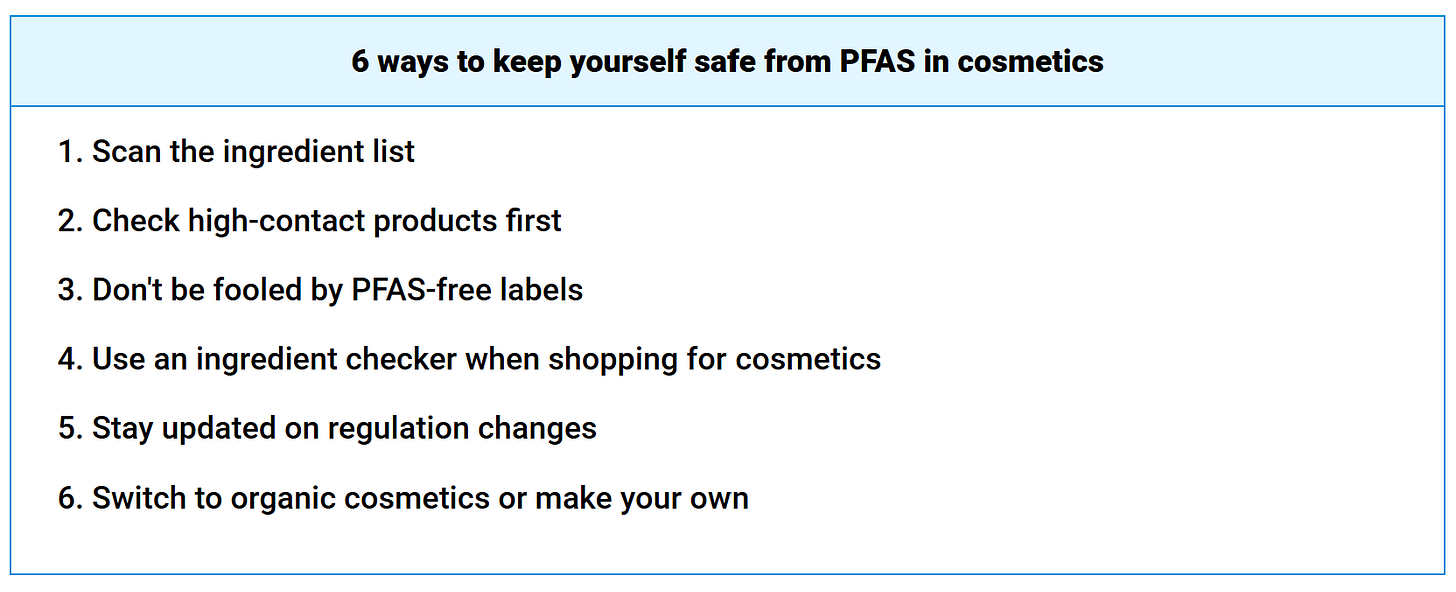
Until then, consumers like you hold more power than you realize. The goal isn’t to toss your whole makeup bag. Instead, make a few smart swaps. Here are steps you can take to reduce your exposure:
Scan for suspicious ingredients — Look for PFAS indicators such as terms like PTFE or any ingredient starting with “perfluoro-” or “polyfluoro-.”15 These prefixes signal fluorinated compounds commonly used to make cosmetics more water-resistant and long-lasting. If you spot them on the label, that product is best avoided.
Reduce exposure by checking high-contact products first — Start by checking cosmetics applied over large areas or touch-sensitive zones like the eyes and lips. Products such as foundation, mascara, and liquid lipstick are most likely to contain PFAS that can be absorbed through the skin or tear ducts.
Don’t just rely on “PFAS-free” labels — A “PFAS-free” stamp is a good starting point, but it’s not a guarantee. Reach out to brands to ask what testing methods they use, how frequently they test, and what they screen for. Transparency matters more than marketing language.16
Use ingredient-checker tools — PFAS can also hide in everyday items like dental floss. Tools like the EWG Skin Deep database17 can help you spot safer alternatives and choose products that better protect your health.
Monitor brand reputation and regulatory changes — Some brands marketed as clean have been named in PFAS lawsuits. Meanwhile, U.S. and E.U. regulators are moving toward tighter restrictions. Following updates from the FDA, EPA, or Environmental Working Group can help you stay ahead.
Go natural — Switch to organic toiletries, including shampoo, toothpaste, antiperspirants, and cosmetics, or better yet, make your own. Many of these products are easy to make using basic ingredients like tallow, coconut oil, baking soda, and essential oils, and there are lots of recipes online.
Frequently Asked Questions (FAQs) About PFAS in Cosmetics
Q: What do PFAS do to your body?
A: PFAS can build up in your body over time and are linked to thyroid dysfunction, reduced immune response, high cholesterol, and several cancers, including kidney, testicular, and prostate. Even small exposures may be harmful in the long term.
Q: Are cosmetics safe from PFAS?
A: No. A federally mandated review by the U.S. Food and Drug Administration (FDA) of 1,744 cosmetic products found 51 PFAS. When the agency evaluated the 25 most used compounds, it found that toxicological data were incomplete or unavailable for most of them.
Q: How common are “forever chemicals” in makeup?
A: Very common. PFAS were detected in 82% of waterproof mascaras, 63% of foundations, and 62% of liquid lipsticks in one major study. Many were marketed as long-wear or waterproof but didn’t list PFAS on the label.
Q: Which products are most likely to contain PFAS?
A: Waterproof mascaras, long-wear foundations, liquid lipsticks, and primers are most likely to contain PFAS. These formulas often rely on fluorinated compounds for durability, smooth application, or resistance to smudging.
Q: How are cosmetics tested for PFAS?
A: Products can be screened for total fluorine (which indicates overall PFAS presence) or through targeted tests for specific compounds. The best testing combines both to ensure no PFAS slip through undetected or mislabeled.
Q: Does the FDA regulate PFAS in cosmetics?
A: No. The FDA does not currently prohibit PFAS intentionally added to cosmetics. In its federally mandated review, the agency acknowledged it lacks sufficient toxicological data to determine the safety of most PFAS used in these products. While PFAS remain legal, the FDA says it will continue monitoring new data and work with the EPA and CDC to improve testing, surveillance, and guidance, acting if safety concerns are identified.
Q: How can I avoid PFAS in cosmetics?
A: Check labels for ingredients with “perfluoro-” or “polyfluoro-.” Focus first on products used daily, applied over large areas, or used near the eyes and lips, such as mascaras, foundations, and lipsticks. Use ingredient-scanning apps and choose brands that publish third-party PFAS test results or offer full transparency.
Q: Are “PFAS-free” claims reliable?
A: Not always. “PFAS-free” is unregulated and often used without lab verification. Ask brands for test results, including total fluorine and targeted PFAS data, to ensure the claim is backed by real science.
Disclaimer: The entire contents of this website are based upon the opinions of Dr. Mercola, unless otherwise noted. Individual articles are based upon the opinions of the respective author, who retains copyright as marked.
The information on this website is not intended to replace a one-on-one relationship with a qualified health care professional and is not intended as medical advice. It is intended as a sharing of knowledge and information from the research and experience of Dr. Mercola and his community. Dr. Mercola encourages you to make your own health care decisions based upon your research and in partnership with a qualified health care professional. The subscription fee being requested is for access to the articles and information posted on this site, and is not being paid for any individual medical advice.
If you are pregnant, nursing, taking medication, or have a medical condition, consult your health care professional before using products based on this content.