
Kids' Backpack Safety — A Guide to Protect Your Child's Back
Is your child's backpack putting their spine at risk? Learn the simple weight rule, fit check, and red flags every parent needs to know this school year.


STORY AT-A-GLANCE
When it comes to a child’s backpack, 10% to 15% of body weight is the maximum safe range, according to the American Academy of Pediatrics (AAP). For example, a backpack that weighs 6.6 to 10 lbs. (3 to 4.5 kg) is recommended for a child weighing 66 pounds (30 kilograms)
5% to 10% of body weight is recommended for smaller children, those who have longer walks or commute, or if pain is already present
Weigh, don’t guess — use a bathroom scale to check. If the pack exceeds the range, remove items or split the load
The way a backpack fits is just as important as its weight. Always use two straps, keep the pack high and snug, and place heavier items close to the spine
Watch for warning signs that a backpack is too heavy, including leaning forward, red strap marks, tingling or numbness, or frequent complaints of back, neck, or shoulder pain

Another school year has started, and for most parents, this means going back to their routine of packing their children's bags and making sure they've got all their books and other learning materials ready every day.
However, many parents often underestimate how fast textbooks, lunch, water bottles, and sports gear add up, leading to a daily load that's far beyond safe limits. As a result, most kids struggle to carry heavy or poorly worn backpacks, which leads to pain, discomfort, and even posture changes.
So the question now is, what's the safe and recommended weight for a child's backpack? I believe there are some basic guidelines that will help avoid putting strain on your child's fragile and growing body.
The Simple Weight Rule Parents Can Use Today
It's easy to assume a pack looks fine because kids sling it over both shoulders without hesitation, but a simple check on the bathroom scale often tells another story. Parents are often surprised the first time they weigh a backpack. What looks like a modest load sometimes turns out to be nearly 20% of a child's body weight — it explains sore shoulders, red strap marks, and the complaints of back pain teachers and clinicians hear each fall.
When it comes to backpacks, what's the ideal weight for a child? The answer varies from one source to another, but all point to one recommendation — children, and even adults, in fact, are not advised to carry more than 15% of their body weight in a backpack.1 So that means if your child weighs 60 pounds (27 kilograms), it's advisable that their backpack only weighs 9 lbs. (less than 4 kg).
The American Academy of Pediatrics recommends a lower load — In an article published in their Grand Rounds Journal, the organization recommends keeping children's backpack load to less than 10% of their body weight — regardless of grade or age.2 According to the study:
"Based on a mean RBW [relative backpack weight] of 11.4% among those reporting pain, the investigators support a recommendation that backpack weight not exceed 10% of a student's body weight for all grades and ages. They caution that younger students may be at higher risk since they weigh less and their packs weigh the same as older students'. Likewise, females are more likely to carry heavier bags despite weighing less than males."3
Remember that everyday items push weight up quickly — A hardcover textbook weighs around 3 lbs. (1.4 kg), while a lunch bag with a full water bottle adds another 2 to 3 lbs. (nearly 1 to 1.5 kg). That's 5 to 6 lbs. (2.2 to 2.7 kg) before including notebooks, supplies, or sports gear. In practice, an elementary student weighing 60 pounds could already be at the 10% threshold with just those basics. This is why experts emphasize one consistent message — Weigh the backpack, don't eyeball it.
The bathroom scale is the fastest way to check — Weigh the child alone, then weigh with the backpack on, and subtract. Compare that number to the guideline. If it exceeds the 10% to 15% range, lighten the load. If your child is smaller, tires easily, or has a long commute, limiting the weight to 5% to 10% of their body weight is recommended.4
What are the signs that a backpack is too heavy? While the guidelines among organizations vary slightly, the underlying principle is the same — once a pack exceeds the safe percentage, the body begins compensating. An article in Iowa Ortho says, "If your child struggles to lift their backpack, leans forward while walking, or complains of neck or back discomfort, it may be a sign their backpack is too heavy or not fitted correctly."5
"Carrying heavy weight, especially if the core muscles are not strong enough, can cause back pain," the Spine Health Foundation said. Leaning forward, arching shoulders, or swinging hips to balance all place strain on developing muscles and joints.6
Weight Chart — Child Weight vs. Safe Backpack Load
Numbers tell a story that words alone cannot. That's why a weight chart is one of the simplest tools you can use to protect a child's spine and shoulders. Putting those percentages into an easy reference chart removes the guesswork. Here's how it looks in practice:
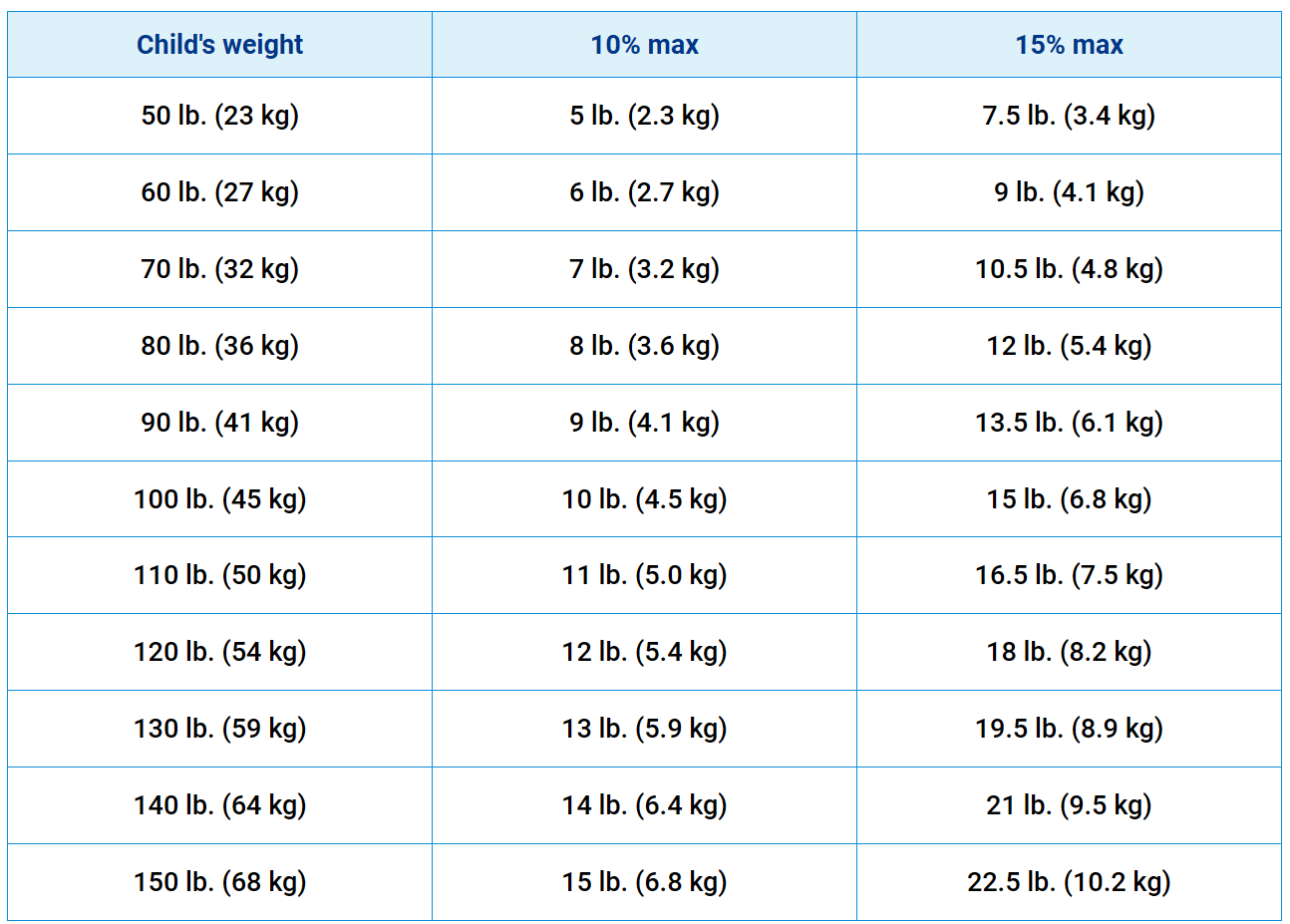
Biomechanics explains why these limits matter — The spine in a growing child is flexible and still developing. When a load exceeds 15% of body weight, the center of gravity shifts backward. To compensate, the student leans forward at the waist, arches the shoulders, or cranes the neck.
This compensation alters your child's "natural posture" — Repeated day after day, these adjustments lead to soreness, fatigue, and sometimes even headaches.7 "These aches and pains can interfere with their ability to concentrate in school, participate in physical activities, and enjoy their daily lives. If left unaddressed, these symptoms can worsen over time, leading to chronic pain and other complications," the National Spine Health Foundation said.
Fit Matters More Than You Think
Even if a backpack falls within the safe weight range, a poor fit still creates strain and discomfort, especially if it hangs too low, pulls unevenly, or shifts around while a child walks. The height of the pack, the way straps sit, and whether chest or waist straps are used all matter as much as the number on the scale.
Do a "60-second fit check" — The quickest way to protect a child's back each morning is to run through a short checklist. In under a minute, you'll be able to spot and fix most problems.8 9 10
60-Second Fit Check
Start with the straps — Choose broad, padded straps that are adjusted and tightened properly so the weight is distributed evenly between both shoulders. Always instruct your child to use both straps when carrying their bag.
Look at where the backpack sits — The top of the pack needs to be aligned near the shoulder blades, while the bottom does not fall below the waist. If it droops lower, the child's body instinctively leans forward to balance the load. Low-hanging packs are one of the most common mistakes.
Chest and waist straps matter more than most parents realize — These extra buckles distribute weight from the shoulders to the torso, taking pressure off the spine.10 They are especially useful when children walk longer distances or carry heavier loads within the safe limit.
Pack their things properly — Place the heaviest items, such as textbooks or laptops, close to the spine. If carrying water bottles, store them upright. Lighter objects like pencil cases or lunch bags belong in outer compartments. The reason is simple — When weight sits close to the spine, the body carries it more naturally. When it sits farther away, the pull increases exponentially, straining the back and shoulders.
Finish with a simple lean test — If the child needs to lean forward or struggles to stand straight, the pack is either too heavy or riding too low. This means the fit or the load is unsafe.
It's important to teach your kid the correct way to wear a backpack — Most children, especially older ones, sling their backpack on one shoulder as opposed to wearing the two straps evenly. While a one-strap carry looks trendy, this causes the load to shift to one side of the body and puts uneven stress. Uneven carrying leads to posture problems and shoulder strain.
Do a regular "backpack audit" as well — Even the best-fitted pack becomes a problem if it's filled with clutter. Iowa Ortho recommends decluttering your child's backpack at least once a week (though you can do this daily as well).11 This means emptying the bag, removing duplicate notebooks, tossing old handouts, and repacking with only what's needed.
The audit is also a chance to reset weight — Many students accumulate unnecessary items — an extra sweatshirt, leftover snacks, or multiple folders slowly increase the pack's burden. Without a regular check, a backpack that was safe last week crosses into unsafe territory. By cleaning it out at the end of the day or before the week starts, you prevent gradual overload.
Do Backpacks Actually Cause Back Pain in Kids?
The National Spine Health Foundation says that when the load is too heavy or if improperly worn, then yes — backpacks will cause back pain among children.12 Kevin Taliaferro, M.D., an orthopedic surgeon at Henry Ford Health, comments:
"It's important to have a good back for your entire life. As adults we're used to dealing with back pain, but more kids are experiencing back pain and it's worrisome. There are some good studies saying it could be related to backpacks."13
Many adolescents are now struggling with back pain — In fact, a study published in the Journal of Orthopaedic & Sports Physical Therapy found that 30% of girls and 26% of boys today deal with acute or subacute lower back pain by the time they're 14 years old; and for 11%, the back pain lasts more than three months.14 "By the age of 17 years, 13% of girls and 26% of boys report having chronic low back pain," the National Spine Health Foundation reports.15
What actually happens inside the body? The spine is designed to carry load in alignment with its natural curves. Excess backpack weight shifts the center of gravity backward. To keep from tipping, the child leans forward. That lean compresses the discs in the lower spine and overstretches muscles in the upper back.
"When properly worn, the back and abdominal muscles support a backpack. These are the strongest muscles in the body, stabilizing the trunk and holding the body in proper postural alignment. Improper backpack use presents some dangers to young, still-growing joints and muscles," an article in Medical Xpress said.
Narrow shoulder straps that dig into soft tissue compress nerves and restrict circulation — Over weeks and months, this constant pressure can hinder circulation, leading to tingling or numbness in the arms. Eventually, this leads to weakness in the hands.16
One persistent myth is that backpacks cause scoliosis — However, the American Academy of Orthopaedic Surgeons confirms that while heavy backpacks cause strain on the spine and back pain, they do not cause structural spinal curves.17 Scoliosis develops for other reasons, such as genetic predisposition or uneven growth. However, poor posture from wearing heavy backpacks can exacerbate the symptoms of this medical condition.
Ignoring poor posture from a heavy backpack could set children up for bad habits that carry into adulthood — A child who learns to slouch forward under a heavy pack may continue that slouch at a desk or while using a phone, reinforcing strain long after the backpack is gone.
Beyond pain, backpacks influence daily performance — A child straining to carry a heavy load tires faster, both physically and mentally. They may restlessly shift in seats, complain during Phys Ed, or hesitate to participate in sports. These could be subtle signs that the heavy load is interfering with the child's ability to function throughout the day.
Clinicians also warn about cumulative effects — Poor posture sets the stage for muscle imbalances.18 Stronger muscles become overworked, while stabilizing muscles weaken from underuse, leading to instability and increasing the chance of injury while doing sports or playing.
Choosing the Right Backpack for Your Child
If you notice that your child is still dealing with the effects mentioned above, even after you've adjusted the weight, it's time to consider switching to a more ergonomic, spine-friendly backpack. Remember, design matters as much as weight, and a well-made pack makes it easier to stay within safe limits. I suggest following this simple checklist:19 20 21 22
6 Tips to Pick the Best Backpack for Your Kid
Find the right size — Ideally, the backpack shouldn't be wider than your child's torso. It also needs to be above the waist, and does not hang more than 4 inches below their waistline.
Check the straps — Choose a backpack with two straps versus one. Look for straps that are wide and padded, so they don't dig into the shoulders and are more comfortable. Having chest/waist straps in a backpack also benefits kids as it helps distribute the weight.
Look for multiple sections and pockets — Not only does it help keep your child's things organized, but it also helps distribute the weight more evenly across the pack.
Don't choose bags that are "too roomy" — According to Taliaferro, having a lot of space in the pack can cause children to fill it to the brim, making it too heavy to carry.
Choose one made with the right material — Lightweight backpacks for elementary students are typically made of cloth or canvas, which are much lighter than leather backpacks.
Includes a reflective material as an added safety feature — This is important, especially if your child walks or bikes to school. An alternative is to stick reflective tape strips on the pack.
When to Switch to a Rolling Bag
The idea of switching to a rolling bag often comes up the moment parents realize how heavy a child's daily load has become. On the surface, the logic seems flawless — take the weight off the spine and let the wheels do the work. If rolling backpacks are allowed at school, this choice is a lifesaver for some children. For others, it introduces a new set of problems.23
While using rolling backpacks for school reduces direct strain on the back and shoulders, it is not a universal solution — Corridors in many schools are crowded. Staircases and tight hallways also make dragging a rolling bag difficult, sometimes dangerous. A child trying to maneuver a large rolling case through a jammed hallway risks tripping other students or being tripped themselves. That is why many schools restrict or even outright ban rolling backpacks.
Another problem is clutter — Rolling backpacks are often larger than standard ones. That extra space invites overpacking. Instead of carrying fewer items, children sometimes load even more into the rolling case, nullifying the weight advantage. It's common to see wheeled bags tipping over from excess weight, which only adds to the frustration.
There are also hybrid versions available, but there are drawbacks — Some bag manufacturers now design convertible packs that switch between shoulder straps and wheels. However, these designs tend to be heavier than standard backpacks even when empty, which offsets their advantage. They're helpful for specific cases, but are not an ideal fix for the general student population.
While the rolling pack seems like an ideal solution to prevent back pain, it can still pose some risks. The smartest path is to test, observe, and adapt. If the child reports less pain and if the school approves its use, wheeled bags may be the right call. If not, a well-fitted, two-strap backpack remains the safest choice.
When to See a Doctor for Kids' Back Pain
Most backpack-related discomfort is resolved when the load is lightened or the fit is corrected. But sometimes, pain is a warning sign of something more serious. Knowing the difference is not just helpful — it is necessary. If your child experiences any of these symptoms, I recommend seeking help from a professional health provider:
Persistent, lingering pain that does not improve — If the pain keeps returning despite corrections, it signals that muscles, joints, or nerves are already inflamed.
Numbness, tingling, or weakness — They may indicate nerve compression that, if left unaddressed, can cause lasting damage.
Changes in gait or posture — Consult with a pediatrician to determine whether muscle imbalance or joint stress is developing.
Night pain or pain that wakes a child — Nighttime pain deserves closer attention, as it sometimes signals underlying conditions beyond backpack load, including stress fractures or spinal abnormalities.
Pain accompanied by systemic symptoms like fever, fatigue, or unexplained weight loss — These symptoms are not typical of mechanical strain. They suggest infection, inflammation, or another medical condition. While rare, they could indicate a serious health issue, so consult with a physician immediately.
When it comes to school-age kids, backpack safety is an essential aspect of their day-to-day life. It's not just about preventing mild soreness, but also recognizing when a common school accessory is causing medical issues. By following the guidelines above and addressing discomfort immediately, you'll be able to protect your child's spine health and keep them comfortable and safe every day.
Frequently Asked Questions (FAQs) About Kids' Backpack Safety
Q: How heavy is a safe backpack load for children?
A: Most medical organizations recommend keeping backpacks under 10% to 15% of a child's body weight. The American Academy of Pediatrics sets 15% as the maximum, although an even safer range of 5% to 10% is advisable for smaller kids or those walking long distances. A practical approach is to start with 10% and only allow up to 15% if the child is comfortable, upright, and not complaining of pain.
Q: What is the correct way for my kid to wear a backpack?
A: The proper way to wear one is to always use both straps, adjust them so the pack sits high and snug, and clip chest or waist straps when available. It's recommended that a backpack rests from the shoulders to the waist — not hang below the waistline. Place heavier items close to the back panel.
Q: Are rolling backpacks better for my child's back?
A: Rolling backpacks remove weight from the shoulders, but they are not always safer in practice. They clutter hallways, trip other students, and become awkward on stairs. They're most helpful for long, flat commutes when schools allow them. If stairs dominate, a well-fitted two-strap pack is usually the better choice.
Q: What are the signs that a backpack is too heavy for my child?
A: Key signs include leaning forward to walk, struggling to put the bag on, red strap marks on the shoulders, tingling or numbness in the arms, or complaints of back or neck pain. If your child needs to lean forward to balance the load, the backpack is already too heavy.
Q: What's the correct position for a backpack on my child's back?
A: It's ideal for your child's backpack to ride from just below the shoulders to the waist. It's best not to let it hang more than 2 to 4 inches below the waistline. Low-hanging backpacks swing, pull the child backward, and force posture compensation.
Q: When is it advisable to see a doctor for my kid's back pain?
A: It's best to see a doctor if the back pain persists after reducing weight and adjusting the fit or if it wakes a child at night or worsens in the morning. Numbness, tingling, or weakness in arms or legs, changes in posture or gait, and having systemic symptoms like fever or fatigue are also signs to visit a physician.
Q: Do one-strap backpacks cause back pain?
A: Yes. Backpacks, especially in children, need to be worn using both straps. One-strap carrying shifts all the weight to one side, stressing the shoulder, neck, and spine. Over time, this uneven load leads to pain and posture issues.
Disclaimer: The entire contents of this website are based upon the opinions of Dr. Mercola, unless otherwise noted. Individual articles are based upon the opinions of the respective author, who retains copyright as marked.
The information on this website is not intended to replace a one-on-one relationship with a qualified health care professional and is not intended as medical advice. It is intended as a sharing of knowledge and information from the research and experience of Dr. Mercola and his community. Dr. Mercola encourages you to make your own health care decisions based upon your research and in partnership with a qualified health care professional. The subscription fee being requested is for access to the articles and information posted on this site, and is not being paid for any individual medical advice.
If you are pregnant, nursing, taking medication, or have a medical condition, consult your health care professional before using products based on this content.