
Are Plastic Cutting Boards Safe?
Your cutting board could be harboring microscopic plastic particles that eventually end up in your body. Here's what you can do to protect yourself.

STORY AT-A-GLANCE
Plastic cutting boards shed microplastics during routine food prep, contributing to increased plastic ingestion that accumulates in organs like the brain and reproductive tissues over time
Research shows knife pressure releases hundreds of plastic fragments per cut, many embedding into food tissue and remaining even after rinsing or cooking
Older, heavily grooved boards release more microplastics, as repeated knife strokes and surface wear accelerate abrasion and contamination during everyday meal prep
Replacing plastic boards with wood, bamboo, or glass reduces microplastic exposure, while proper cleaning and timely replacement help limit bacterial and chemical risks
Beyond cutting boards, reducing exposure to microplastics requires filtering water, avoiding plastic packaging, choosing natural fabrics, and addressing hormone disruption caused by estrogen-mimicking plastic chemicals

When was the last time you paid attention to what your cutting board is made from? If you’re still using a plastic one, the following information will hopefully make you reconsider. As it stands, experts estimate that humans ingest around 5 grams of plastic a week, which is about the same weight as a credit card. While your body can eliminate most of this microplastic, the smallest pieces have the ability to accumulate in your vital organs, such as your brain and reproductive organs.
Microplastics released during food preparation is quickly becoming a public health problem, so much so that mainstream media outlets have picked up on this topic. In a report published by TIME, they cited research showing that a single knife stroke releases 100 to 300 pieces of microplastics from plastic cutting boards. In addition to this, around 50% of the microplastics released from the board are washed down in the drain, which ends up in the environment. The other 50% is consumed alongside the food.1
The Case Against Plastic Cutting Boards
In a 2022 study published in the International Journal of Environmental Research and Public Health, researchers set out to identify the amount of microplastics that transfer onto food:2
Framework of the study — To mimic real life usage, the researchers used chicken and fish samples. They then analyzed edible tissue after preparation and measured microplastic presence directly in the food itself. What they found was consistent across samples. Food prepared on plastic cutting boards contained identifiable plastic fragments that matched the boards used during cutting.
Cutting meat off the bone increases plastic contamination — When chicken or fish was carved directly off the bone on plastic cutting boards, researchers found significantly more microplastic contamination than when boneless fillets were prepared.
The added force needed to cut along bone increases pressure and abrasion on the board, which releases more plastic fragments into the food. So, if you routinely break down whole cuts on plastic surfaces, your microplastic exposure likely goes up.
Washing food helps, but does not solve the problem — Rinsing reduced the number of detectable microplastics, yet plastic fragments remained embedded in the food tissue even after washing.
This is an important finding because it addresses a common assumption — you might think a quick rinse fixes contamination, especially if you just used powerful force to chop an ingredient, but the data shows otherwise. Once fragments are embedded into soft tissue, surface washing removes only part of the load.
Analytical techniques used — To confirm where the plastic came from, the researchers examined the chemical composition of the particles found in the food. They identified polyethylene as the material of the cutting boards used during preparation. This ruled out packaging or environmental contamination as the primary source. In other words, the board itself was the origin point of microplastics.
After analysis was complete, they discovered that there were between 0.03 to 1.19 particles per gram of chicken meat. In fish, 0.014 to 2.6 particles per gram were discovered.
The age and quality of the cutting board impacts the amount of microplastics released — The study also measured physical properties of the boards, including hardness and wear resistance, and compared those traits with contamination levels. Softer, more worn boards released more fragments during cutting. Old boards that look scratched and well-used shed more material than newer ones. The surface grooves act like weak points where plastic breaks away faster after each knife stroke.
Key takeaway — The study did not compare health outcomes between groups because that was not its aim, and the authors clearly state this limitation in their research. Instead, the value lies in confirming that cutting boards are another point of exposure to microplastics.
Awareness of this issue gives you the power to act and take control of your health. I recommend that you replace all your cutting boards with hardwood, bamboo or glass varieties. But if you’re in a tight spot and can’t replace your board just yet, there are strategies available that you can do to minimize your exposure to microplastics (more on this later).
Sanitation and Safe Use of Cutting Boards of All Kinds
Aside from exposure to microplastics, another issue that more people need to be aware of regarding cutting boards is sanitation. These kitchen items harbor foodborne pathogens that can cause food poisoning upon exposure when not cleaned regularly. Here’s how you can reduce your risk:
Wash after every use — The U.S. Food and Drug Administration (FDA) recommends that you wash your cutting boards, as well as dishes, utensils, and countertops with hot, soapy water after food preparation.3
Bamboo cutting boards are a great choice, as they’re generally harder and less porous than hardwood, which makes them more resistant to harboring bacteria.4
Disinfect and condition wood cutting boards with coconut oil — If you’re using a wooden cutting board, one way to keep it from harboring bacteria is wiping it with high-quality coconut oil. As mentioned in a previous article, coconut oil has natural antimicrobial properties. The oil also helps keep the wood from drying out.
If you have a bamboo cutting board, the cleaning process is the same. Use hot, soapy water, then rub it with coconut oil to eliminate remaining bacteria and retain moisture.
When to replace plastic cutting boards — Like most kitchen utensils that see constant use, your cutting board will eventually need to be replaced. So, what’s a good marker to buy a new one? Feel the knife grooves. When these become deep, or when stains or odors persist within these crevices, that’s the time to buy a new one. The same logic also applies to wooden and bamboo boards, as these grooves can allow bacteria to fester.
Why you should always use two cutting boards — Using separate cutting boards for raw meat and produce isn’t just a nice idea — it’s a basic food safety measure. Cross-contamination can easily happen if the same surface is used for both, even with a quick rinse in between. Keep two boards on hand at all times, ideally in different colors, so you can quickly tell them apart.5
What Does NSF Certification on Plastic Boards Actually Mean?
Have you recently bought a plastic cutting board certified by the National Sanitation Foundation (NSF) but don’t know what it really stands for? Here’s what it means:
The history of NSF — For context, NSF is a public health organization based in Ann Arbor, Michigan, that “facilitates the development of standards, and tests and certifies products for the food, water, and consumer goods industries.”6 According to their website, their testing methods have contributed to more than 75 standards and protocols for food equipment safety in the restaurant industry.7
Standards help minimize dangers — NSF tests for a wide range of plastics within consumer and food service products. These include polyvinyl chloride (PVC), acrylonitrile butadiene styrene (ABS), and polypropylene (PP).8 If you work in the food service industry, or have already bought a plastic cutting board beforehand, look for the ANSI 51 label. As noted by the NSF:9
“NSF/ANSI 51 establishes minimum public health and sanitation requirements for materials and finishes used in the manufacture of commercial foodservice equipment (such as broilers, beverage dispensers, cutting boards and stock pots) and its components (such as tubing, sealants, gaskets and valves).”
Plastic vs. Wood Cutting Board — Which One Is Safest to Use?
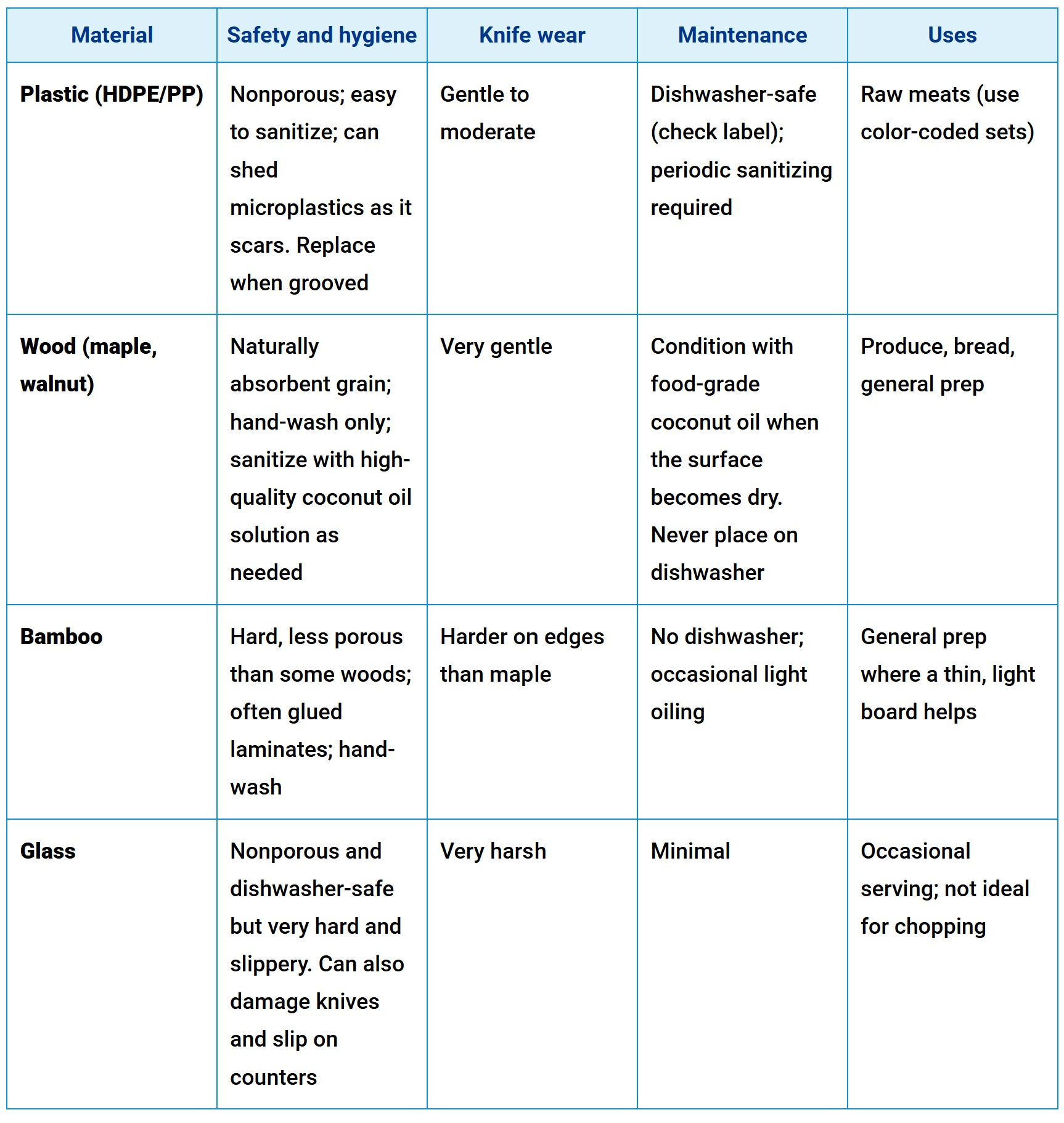
While a product certified by reputable organizations will bring some peace of mind for consumers, it would be wise not to heavily lean on that. As noted earlier, plastic cutting boards eventually degrade, so as soon as you can, switch your plastic boards for wooden, glass, or bamboo boards.To help you make a more informed decision, refer to the table below:
Additional Strategies to Reduce Microplastic Exposure
Plastic cutting boards and similar kitchen utensils aren’t the only source of microplastics. In fact, plastic is all around you — from the keyboard on your computer to the buttons on your smartphone, your body is touching plastic all the time. To reduce your exposure, here are some practical tips:
Filter your tap water and avoid plastic bottles — Microplastics are now showing up regularly in tap water, which means filtering what you drink isn’t a luxury anymore, it’s a necessity. Look for a high-quality filtration system specifically rated to remove microplastics and be sure it carries the proper certification. In addition, if you find yourself in a situation where you absolutely need to buy bottled water, choose glass over plastic.
Furthermore, if your home has hard water, simply boiling it before use can significantly cut down microplastic content.10 This simple but handy tip will give you cleaner water for daily use.
Carefully scrutinize food packaging — Plastic packaging remains one of the most common ways microplastics contaminate your food. Be careful about what you buy — seek out products packaged in glass whenever possible. At home, replace plastic wrap and plastic storage containers with safer, non-plastic alternatives.
These small shifts greatly reduce how much plastic comes into direct contact with what you and your family eat. Also, adopt a strict “no microwaving in plastics” rule. That’s because heat accelerates chemical leaching from plastics straight into your food.
Review your kitchen utensil staples — Simple upgrades in your kitchen can meaningfully lower plastic exposure. As mentioned above, start by swapping plastic cutting boards for wooden, bamboo or glass versions. If plastic kitchen utensils are still in your drawers, consider buying wooden or stainless steel versions.
Choose natural fibers for your clothing — Your wardrobe also contributes to microplastic exposure, particularly if you wear a lot of synthetic fabrics like polyester. Whenever you can, opt for clothing and household textiles made from natural fibers such as organic cotton, wool, and linen. For the synthetic items you already own, wash them less often.
When washing synthetics, installing a microfiber filter in your washing machine helps capture the fibers released during each cycle, preventing them from entering waterways — and ultimately ending up back in your environment and your body.
Consider progesterone to support estrogen balance — Many plastics exert estrogen-like effects because they contain xenoestrogens — endocrine-disrupting chemicals (EDCs) that imitate estrogen and interfere with hormonal balance.
This is a significant health problem, as excess estrogen fuel can undermine cellular and mitochondrial function. While reducing plastic exposure is crucial, natural progesterone can help counter estrogen dominance. It works as an estrogen antagonist, helping buffer some of the negative impacts of elevated estrogen load due to environmental exposure.
How to Use Progesterone
Before you consider using progesterone, it is important to understand that it is not a magic bullet, and that you get the most benefit by implementing a Bioenergetic diet approach that allows you to effectively burn glucose as your primary fuel without backing up electrons in your mitochondria that reduces your energy production. My new book, “Your Guide to Cellular Health: Unlocking the Science of Longevity and Joy,” covers this process in great detail.
Once you have dialed in your diet, an effective strategy that can help counteract estrogen excess is to take transmucosal progesterone (i.e., applied to your gums, not oral or transdermal), which is a natural estrogen antagonist. Progesterone is one of only three hormones I believe many adults can benefit from. (The other two are DHEA and pregnenolone.)
I do not recommend transdermal progesterone, as your skin expresses high levels of 5-alpha reductase enzyme, which causes a significant portion of the progesterone you’re taking to be irreversibly converted primarily into allopregnanolone and cannot be converted back into progesterone.
Ideal Way to Administer Progesterone
Please note that when progesterone is used transmucosally on your gums as I advise, the FDA believes that somehow converts it into a drug and prohibits any company from advising that on its label. This is why companies promote their progesterone products as “topical.”
However, please understand that it is perfectly legal for any physician to recommend an off-label indication for a drug to their patient. In this case, progesterone is a natural hormone and not a drug and is very safe even in high doses. This is unlike synthetic progesterone called progestins that are used by drug companies, but frequently, and incorrectly, referred.
Dr. Ray Peat has done the seminal work in progesterone and probably was the world’s greatest expert on progesterone. He wrote his Ph.D. on estrogen in 1982 and spent most of his professional career documenting the need to counteract the dangers of excess estrogen with low-LA diets and transmucosal progesterone supplementation.
He determined that most solvents do not dissolve progesterone well and discovered that vitamin E is the best solvent to optimally provide progesterone in your tissue. Vitamin E also protects you against damage from LA. You just need to be very careful about which vitamin E you use as most supplemental vitamin E on the market is worse than worthless and will cause you harm not benefit.
It is imperative to avoid using any synthetic vitamin E (alpha tocopherol acetate — the acetate indicates that it’s synthetic). Natural vitamin E will be labeled “d alpha tocopherol.” This is the pure D isomer, which is what your body can use.
There are also other vitamin E isomers, and you want the complete spectrum of tocopherols and tocotrienols, specifically the beta, gamma, and delta types, in the effective D isomer. As an example of an ideal vitamin E, you can look at the label on our vitamin E in our store. You can use any brand that has a similar label.
You can purchase pharmaceutical grade bioidentical progesterone as Progesterone Powder, Bioidentical Micronized Powder, 10 grams for about $40 on many online stores like Amazon. That is nearly a year’s supply, depending on the dose you choose.
However, you will need to purchase some small stainless steel measuring spoons as you will need a 1/64 tsp, which is 25 mg and a 1/32 tsp, which is 50 mg. A normal dose is typically 25 to 50 mg and is taken 30 to 60 minutes before bed, as it has an anti-cortisol function and will increase GABA levels for a good night’s sleep.
If you are a menstruating woman, you should take the progesterone during the luteal phase or the last half of your cycle, which can be determined by starting 10 days after the first day of your period and stopping the progesterone when your period starts.
If you are a male or non-menstruating woman, you can take the progesterone every day for four to six months and then cycle off for one week. The best time of day to take progesterone is 30 to 60 minutes before bed as it has an anti-cortisol function and will increase GABA levels for a good night’s sleep.
This is what I have been personally doing for over a year with very good results. I am a physician so do not have any problems doing this. If you aren’t a physician, you should consult one before using this therapy, as transmucosal progesterone therapy requires a doctor’s prescription.
For a complete guide to reducing your plastic burden, including my full plastic detox protocol, see my new book, “Microplastics Cure: Total Body Cleanse,” which comes out on February 3, 2026.
Frequently Asked Questions (FAQs) About Plastic Cutting Boards
Q: Why are plastic cutting boards considered a health risk?
A: Plastic cutting boards shed microplastics during routine food preparation. These fragments can transfer into food, accumulate in the body over time, and contribute to overall microplastic exposure.
Q: How many microplastics are released when cutting food on plastic boards?
A: Research shows a single knife stroke can release 100 to 300 microplastic particles, with about half ending up in food and the rest entering wastewater and the environment.
Q: Does washing or cooking food remove microplastics?
A: Rinsing food can reduce surface contamination but does not eliminate embedded microplastics. Cooking also fails to remove them, as plastic particles do not break down at normal cooking temperatures.
Q: Do older or heavily used cutting boards increase exposure?
A: Yes. Worn, scratched plastic boards release more microplastics due to increased abrasion. Repeated knife strokes and deep grooves significantly raise contamination levels over time.
Q: What are safer alternatives strategies to reduce microplastic exposure?
A: Switching to wood, bamboo, or glass cutting boards lowers exposure. Additional steps include filtering drinking water, avoiding plastic food packaging, choosing natural fabrics, and minimizing plastic use throughout daily life.
Disclaimer: The entire contents of this website are based upon the opinions of Dr. Mercola, unless otherwise noted. Individual articles are based upon the opinions of the respective author, who retains copyright as marked.
The information on this website is not intended to replace a one-on-one relationship with a qualified health care professional and is not intended as medical advice. It is intended as a sharing of knowledge and information from the research and experience of Dr. Mercola and his community. Dr. Mercola encourages you to make your own health care decisions based upon your research and in partnership with a qualified health care professional. The subscription fee being requested is for access to the articles and information posted on this site, and is not being paid for any individual medical advice.
If you are pregnant, nursing, taking medication, or have a medical condition, consult your health care professional before using products based on this content.