
Could the Shape of Your Behind Reveal a Hidden Health Risk?
Are you literally sitting your life away? Researchers are weighing in on the consequences of a sedentary lifestyle & how the shape of your buttocks could provide insights into your risk for diseases.

STORY AT-A-GLANCE
Americans spend about nine hours sitting and nearly five hours on their phones daily, contributing to a sedentary way of life
In a featured study presented at the Radiological Society of North America (RSNA), researchers found that muscle shape, not size, may reveal early metabolic changes and even signal disease risk
The World Health Organization (WHO) advises getting at least 150 minutes of moderate activity or 75 minutes of vigorous activity each week. Yet many people fall short of these targets because inactivity significantly raises the risk of cardiovascular disease, Type 2 diabetes, and other cancers
Long, unbroken sitting bouts are associated with circulation problems, back pain, brain fog, higher cancer risk, and an increased risk of Type 2 diabetes
Shape yourself up for better health by standing more, walking whenever you can, eating a nutritious diet, and getting enough sleep and sunlight

Americans are tired — 44% of employees are feeling burned out at work1 and about a third of adults sleep less than seven hours a night.2 Dragging through the day with too little rest, many end up doing the only thing that feels possible: staying seated. Roughly 80% of jobs are sedentary,3 and adults now spend close to nine hours a day sitting.4
People sit at work, sit on the commute home, then collapse on the couch only to stream a movie or idly scroll on their phones for three to five hours to recover from the stress of the day.5 While this kind of self-soothing to fight hustle culture may feel comfortable at first, it can shape your overall health for the worse.
With this thought in mind, researchers are now asking what shapes people’s health. Beyond habits and numbers, even the contours of the body may hold clues about what’s happening inside.

How the Shape of Your Buttocks Could Signal Diabetes Risk
The featured study, presented at the Radiological Society of North America (RSNA) Annual Meeting, analyzed more than 61,290 MRI scans from the UK Biobank database to explore how the shape of the gluteus maximus — the largest muscle in the buttocks — changes with aging, lifestyle, frailty, and Type 2 diabetes.6
What sparked this research? Researchers suspected that muscle shape might reveal more about health than fat content. “Unlike past studies that mainly looked at muscle size or fat, we used 3D shape mapping to pinpoint exactly where the muscle changes, giving a much more detailed picture,” said Marjola Thanaj, Ph.D., senior research fellow at the University of Westminster’s Research Centre for Optimal Health.7
What did MRI mapping reveal? The results showed two patterns: “outward deformation” linked to higher fitness and “inward deformation” tied to aging, frailty, and sedentary time. Thanaj said:8
“People with higher fitness, as measured by vigorous physical activity and hand grip strength, had a greater gluteus maximus shape, while aging, frailty, and long sitting times were linked to muscle thinning.”
What did they discover about diabetes? In participants with Type 2 diabetes, men showed muscle shrinkage, while women had enlarged gluteus maximus muscles — likely due to fat infiltration. These gender-specific changes suggest men and women respond differently to the same disease.
“Shape changes in the gluteus maximus may indicate early functional decline and metabolic compromise in people with Type 2 diabetes,” Thanaj noted.9
Frailty also left its mark — The research showed that men categorized as frail had widespread muscle thinning, while women showed smaller, localized changes. These findings highlight how muscle shape could reflect overall resilience and health status.10
Why does this matter? The gluteus maximus is one of the body’s largest muscles and plays a key role in metabolic health. According to lead author E. Louise Thomas, Ph.D., professor of metabolic imaging at the University of Westminster’s School of Life Sciences, these shape changes may help identify early signs of metabolic compromise before other symptoms appear.11
A Global Picture of Physical Inactivity
Physical activity is one of the most potent ways to prevent chronic disease and support mental well-being, yet people are moving less than ever. According to the World Health Organization (WHO), about 1.8 billion people (31% of adults) failed to meet recommended activity levels in 2022.12
Since 2010, global inactivity has climbed by 5 percentage points, and this trend shows no signs of slowing. If it continues, inactivity could reach 35% by 2030, putting millions at risk for diseases that shouldn’t happen in the first place.
People don’t meet movement quotas — The WHO advises getting at least 150 minutes of moderate activity or 75 minutes of vigorous activity each week. Yet many people fall short of these targets, significantly raising their risk of cardiovascular disease, Type 2 diabetes, breast and colon cancer, cognitive decline, and more.13
Inactivity isn’t spread evenly across the globe — Some regions are far more affected than others. High-income Asia Pacific tops the list with 48%, followed closely by South Asia at 45%. Compare that to 28% in high-income Western countries and just 14% in Oceania.14
Women and older adults move less — Globally, 34% of women are inactive compared to 29% of men, and adults over 60 are the least active — a troubling trend given the importance of movement for healthy aging.15
Common barriers keep people from moving — Physical activity includes any movement, such as walking, cleaning, or gardening, while exercise refers to structured workouts. But even with these options, many people struggle to stay active due to low motivation, busy schedules, stress, or because they simply don’t enjoy the activity.16
Signs of a Sedentary Life
When most people hear “sedentary,” they picture someone who never sets foot in a gym. But the truth is far more nuanced. Researchers define a sedentary lifestyle as spending most of your waking hours sitting, reclining, or lying down, while expending very little energy — typically less than 1.5 metabolic equivalents (METs).17 Below are common signs:
You feel consistently tired — It’s easy to blame fatigue on a packed schedule, but chronic tiredness often stems from inactivity. When you move very little, your heart, lungs, and muscles gradually lose conditioning. Ironically, the less you do, the more exhausted you feel.18
You start gaining weight — Hours of sitting translate to fewer calories burned and a slower metabolism. Over time, this can lead to subtle but steady weight gain, especially around the midsection.19
You get sad easily — Because of your lack of movement, your mental health might take a downturn, since staying still does not allow your body to make feel-good hormones.20
There’s nothing wrong with sitting down and taking a break because your body needs moments of rest. But the problem begins when those breaks stretch into hours and become your default state.
Prolonged Sitting Is Linked to Serious Health Problems
Spending hours in a chair every day doesn’t just leave you “a little stiff.” Research shows that prolonged sitting can affect nearly every major system in your body negatively, as it:
Slows your circulation — When you sit for long stretches, blood and fluid tend to pool in your legs. This can lead to swelling, heaviness, and, in severe cases, increased clot risk.21
In a landmark population-health review in Exercise and Sport Sciences Reviews, researchers determined the risk of venous thromboembolism (VTE) associated with prolonged work- and computer-related seated immobility, saying:
“Prolonged work- and computer-related seated immobility increases the risk of VTE. We suggest that there needs to be both a greater awareness of the role of prolonged work-related seated immobility in the pathogenesis of VTE, and the development of occupational strategies to decrease the risk.”
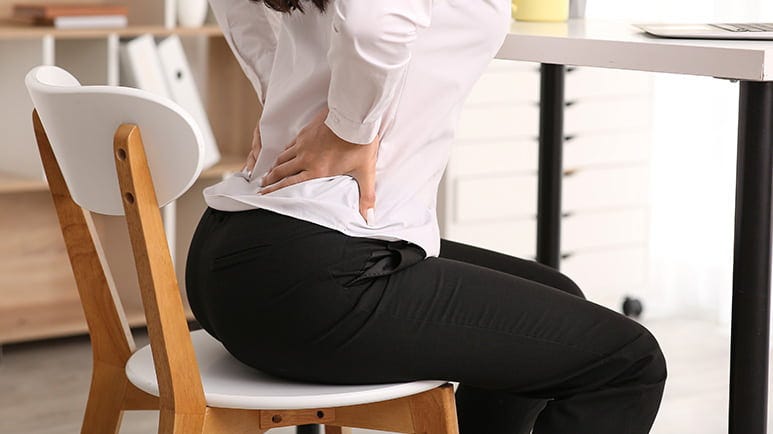
Wrecks your posture, spine, and glutes — Hours of slouching at a desk overload your spine, tighten hip flexors, weaken your core, and even “switch off” your glute muscles.22
In a 2020 study published in Medicina (Kaunas), 30 adolescent participants were asked to sit in a slumped posture for 30 minutes while using a mobile device. Electromyography showed no significant change in trunk muscle fatigue.23
Still, adolescents with chronic lower back pain reported significantly greater back discomfort than healthy peers, leading the authors to conclude that prolonged slumped sitting increases the risk of lower back discomfort, especially in those who already have pain.24
Nudges your brain toward fog and memory problems — Spending too much time sitting doesn’t just affect your body; it can cloud your mind.
Researchers from Iowa State University surveyed more than 3,000 adults from all 50 U.S. states during the first months of COVID-19. People reported how their sitting, screen time, and exercise had changed since the pandemic, and rated their mental health. According to the researchers:25
“In the second study, we found that, on average, people saw their mental health improve over the eight-week period ... People adjusted to life in the pandemic. But for people whose sitting times stayed high, their depressive symptoms, on average, didn’t recover in the same way as everyone else’s.”
Raises your long-term cancer risk — Prolonged sitting is now recognized as an independent risk factor for several cancers, right alongside diet and smoking.
A study in Cancer Causes & Control followed 22,097 postmenopausal women for about eight years using accelerometers to track sitting time. Every additional two hours of daily sitting was linked to roughly a 6% increase in overall cancer risk, and longer, unbroken sitting bouts were especially associated with higher risks of breast, lung, and endometrial cancers. The researchers’ recommendations are:26
“These findings add to a growing body of evidence indicating that limiting sedentary behaviors may help reduce risk of cancers. Additionally, our results support public health messaging encouraging older adults to sit less and move more throughout the day to promote healthy longevity.”
Damages your heart and metabolism — Sitting for long periods is strongly linked to higher blood pressure, poor blood sugar control, larger waistlines, and an increased risk of heart disease and diabetes even if you exercise regularly.27
An 11-year follow-up from the Norwegian HUNT Study, published in Diabetologia, tracked 28,051 adults to see who developed type 2 diabetes. Overall, people who sat for eight hours or more a day had about a 17% higher risk of diabetes than those who sat for four hours or less. When researchers looked only at people who were very inactive in their free time, they concluded that:28
“Our findings suggest that total sitting time has little association with diabetes risk in the population as a whole, but prolonged sitting may contribute to an increased diabetes risk among physically inactive people.”29
Can You ‘Out-Exercise’ the Bad Effects of Prolonged Sitting?
It’s tempting to think that a daily workout cancels out hours spent sitting. Unfortunately, research shows that’s not how the body works. Exercise is important, but it doesn’t erase the damage caused by being sedentary. Here’s why:
Exercise can’t undo the harm of sitting — Health benefits come from pairing structured workouts with frequent movement throughout the day. A single gym session doesn’t offset eight hours in a chair because your body needs to stand, feel like it’s shifting postures, and needs to move.
Sitting too much can cancel out the benefits of exercise — A systematic review of 47 studies on sedentary behavior, published in the Annals of Internal Medicine, found that spending long hours sitting each day causes harmful effects that outweigh the positive impact of physical activity.30
Sedentary habits raise your risk of early death even if you work out — A 2015 study in PLoS One found that people who rarely exercised and sat for long periods faced a higher risk to their health.31
“Both high levels of sedentary time and low levels of moderate to vigorous physical activity are strong and independent predictors of early death from any cause,” the researchers said. “Whether a high physical activity level removes the increased risk of all-cause mortality related to sedentariness requires further investigation.”
A rigorous exercise routine may help prevent disease, but it’s not enough on its own — it’s best to add small movements throughout the day. Walking is the easiest — it’s free, safe, and hard to overdo. For more tips, read “Whether You Count Steps or Time Your Walk, What Matters Is Getting Outdoors.”
How to Stand Up, Shape Up, and Get Healthier
If you’re worried about getting sick — especially if you know you have a family history or genetic risk for Type 2 diabetes, heart problems, or other chronic diseases — spending less time sitting down in front of the TV is one of the simplest ways to take control of your health.
Move every 30 minutes — Even if your job or lifestyle involves sitting, make an effort to break it up. Set a reminder to stand up and move around every half hour. Walk around your house, climb stairs, or step outside for fresh air. Invest in a standing desk or walking pad to help you stay active, even if you’re working. Short bursts of activity help your circulation and prevent dangerous blood pooling in your legs. I do this myself and notice better energy and clearer focus throughout the day.
Incorporate walking into your lifestyle — Whenever you can, walk instead of driving or sitting. If you’re making a phone call, walk while you talk. Park further from the entrance when you run errands. If you have a dog, add an extra loop to your usual walk. Walking doesn’t require gym memberships or fancy equipment — it’s free, easy, and one of the most effective ways to lower your heart disease risk.
Make smart food swaps — Your brain runs on energy, and when your cells don’t get enough, mood issues like anxiety and depression can creep in. Start by fueling up with easy-to-digest carbs like fresh fruit and white rice. Most people do well with around 250 grams a day, and if you’re active or athletic, you’ll likely need more.
Just as important is to ditch seed oils and processed foods loaded with linoleic acid (LA), which can harm your mitochondria. Instead, cook with stable fats such as grass-fed butter, ghee, or beef tallow — they’re far better for your cells and overall health.
Let early morning sunlight reset your body and mind — Natural light in the morning boosts your endorphins, lifts your mood, and recharges your cells. Try to get outside every day, especially in the morning, to help reset your internal clock.
Restore balance with sleep and calm — Sleep is when your body repairs and resets. Without it, your emotional health suffers. Step outside soon after waking to anchor your circadian rhythm, and at night, create a wind-down routine: Dim the lights, skip screens, and keep your bedroom completely dark.
Frequently Asked Questions (FAQs) About Prolonged Sitting
Q: Why are so many Americans exhausted but still sitting all day?
A: Many Americans are running on empty. About 44% of employees feel burned out, and a third sleep less than seven hours. When you’re that tired, movement feels impossible, so most people default to what’s easiest: sitting almost all day.
Q: What did researchers at the Radiological Society of North America (RSNA) find out about the gluteus maximus?
A: They analyzed over 61,000 MRI scans from the UK Biobank and mapped the gluteus maximus in 3D. They found shape changes linked to fitness, aging, frailty, long sitting, and Type 2 diabetes, suggesting buttock muscle shape reflects underlying metabolic health.
Q: How much movement does the World Health Organization (WHO) recommend?
A: The WHO recommends at least 150 minutes of moderate activity or 75 minutes of vigorous activity weekly, but many people still have difficulty reaching that threshold.
Q: What serious health problems are linked to prolonged sitting?
A: Prolonged sitting slows circulation and increases blood clot risk, worsens back pain and posture, and is tied to higher rates of depression, anxiety, cancer, heart disease, larger waistlines, poor blood sugar control, and Type 2 diabetes, especially in inactive people.
Q: Can you immediately offset the effects of prolonged sitting?
A: No. Studies show long sitting still raises your risk of early death, heart disease, and diabetes even if you exercise. Your body does best when formal workouts are combined with frequent movement breaks and regular walking throughout the day.
Disclaimer: The entire contents of this website are based upon the opinions of Dr. Mercola, unless otherwise noted. Individual articles are based upon the opinions of the respective author, who retains copyright as marked.
The information on this website is not intended to replace a one-on-one relationship with a qualified health care professional and is not intended as medical advice. It is intended as a sharing of knowledge and information from the research and experience of Dr. Mercola and his community. Dr. Mercola encourages you to make your own health care decisions based upon your research and in partnership with a qualified health care professional. The subscription fee being requested is for access to the articles and information posted on this site, and is not being paid for any individual medical advice.
If you are pregnant, nursing, taking medication, or have a medical condition, consult your health care professional before using products based on this content.