
Can Menopause Be Reversed?
Menopause might not be a permanent shutdown - a fascinating new study shows that your ovaries could be 'reactivated' by restoring mitochondrial energy, not just hormones.


STORY AT-A-GLANCE
Emerging research shows that human egg cells resist mitochondrial aging, challenging the idea that menopause is irreversible
Scientists have successfully reactivated dormant ovarian follicles in women with premature ovarian insufficiency using stem cell strategies and metabolic interventions
Mitochondrial health, not egg depletion, may be the key to reversing menopause symptoms and restoring reproductive function
Hormones like DHEA, T3, and progesterone, along with nutrients like vitamin A and E, are being studied for their role in rejuvenating ovaries
These findings suggest menopause may be a reversible metabolic state — not a permanent shutdown

For decades, conventional medicine has insisted that every woman is born with all the eggs she’ll ever have. When that limited supply runs out, then an irreversible endpoint is reached — menopause. However, a new study discovered something fascinating: The egg cells of a woman, called oocytes, do not age in the same way as other cells in the body do.
So if this is true, then is menopause permanent, or is it just a metabolic shutdown waiting to be reversed? Let’s explore what the latest science says.
What Really Happens During Menopause (and Why It’s Misunderstood)
Menopause is defined as the permanent cessation of menstruation for 12 consecutive months, typically occurring between ages 45 and 55. It marks the end of a woman’s reproductive window and is characterized by symptoms such as irregular or missed periods, hot flashes, night sweats, vaginal dryness, mood swings, and fatigue. About half the world’s population is in the midst of this natural life stage at any given time.1
The common assumption is that menopause symptoms are the result of ovarian aging — basically, the ovaries, the primary female reproductive organs, are no longer functioning. But what if the problem isn’t just the ovaries? What if it’s the energy system behind them?
A groundbreaking study challenges conventional belief about menopause — A recent study published in Science Advances, led by researchers from the Penn State University, took a closer look at how human egg cells change with age. Their goal was to identify if these cells accumulate mtDNA mutations due to the aging process.2
What the researchers looked at — The research team analyzed 80 single oocytes from 22 women aged 20 to 42 who were undergoing in-vitro fertilization (IVF) treatment. They also examined the women’s blood and saliva to compare how mitochondrial DNA (mtDNA) mutations accumulated across different tissues.
The researchers used a cutting-edge technique called duplex sequencing, which is incredibly accurate and capable of detecting even ultra-rare mutations that older methods might miss.
What the data revealed — The study authors found that while blood and saliva showed the expected increase in mtDNA mutations with age, egg cells did not. Regardless of whether a woman was 22 or 42, her oocytes maintained similar levels of mitochondrial genetic stability.
This finding suggests that, unlike other cells in the body, human egg cells have mechanisms in place to protect their mitochondrial DNA from age-related damage. This protective effect seems to last at least through the early 40s.
“In oocytes, mutations with high allele frequencies were less prevalent in coding than noncoding regions, whereas mutations with low allele frequencies were more uniformly distributed along the mtDNA, suggesting frequency-dependent purifying selection,” the study authors said.
“Thus, mtDNA in human oocytes is protected against accumulation of mutations with aging and having functional consequences. These findings are particularly timely as humans tend to reproduce later in life.”
This idea is backed up by clinical observations — Women with premature ovarian insufficiency (POI), a condition often labeled irreversible, have undergone experimental therapies that reawakened their ovaries, restored menstruation, and even led to successful pregnancies.3
Even Ray Peat, Ph.D., a pioneer in Bioenergetic Medicine, had long critiqued the mainstream concept of menopause as a one-way decline. In Georgi Dinkov’s blog, he discussed how Peat proposed that menopause is the female counterpart of male andropause or hypogonadism — it’s a hormonal slowdown, not a structural failure.4
How Do Ovaries Age and Can the Process Be Reversed?
Most women assume ovarian aging is a slow, irreversible march toward infertility. But that assumption falls apart when you look at the biology (and the data). Ovarian aging isn’t simply about the number of eggs you have left. As the featured study highlighted, it’s about whether a woman’s metabolic system is supporting her ovarian function.
The ovaries depend on a constant flow of cellular energy to do their job — They coordinate menstrual cycle, produce hormones, and release mature eggs. So when mitochondria become sluggish, whether it’s because of inflammation, environmental toxins, or hormonal imbalance, ovarian function suffers. But that doesn’t mean it’s permanently broken.
Researchers from several studies are now confirming this — In 2021, a small study published in Menopause journal found that injecting a combination of platelet-rich plasma (PRP) and follicle-stimulating hormone (FSH) directly into the ovaries shows promise in restoring ovarian function in women with early menopause.5 According to a commentary on Medscape:
“[M]enstruation resumed within a mean of about 5 weeks for 11 of 12 patients with early menopause who were treated with the technique. One patient achieved a clinical pregnancy.”6
There are also emerging regenerative medicine strategies for treating premature ovarian insufficiency (POI) — This is a condition in which a woman’s ovaries lose normal function before age 40, leading to infertility, hormonal problems, and reduced follicle count. According to animal studies, using stem cells may restore ovarian tissue function.7
What these studies reveal is that the structure of the ovaries may not degrade the way scientists once believed. Instead, the core issue is metabolic dysfunction — and this is fixable. That’s where mitochondrial support comes in.
What Are the Current Methods for Reversing Menopause?
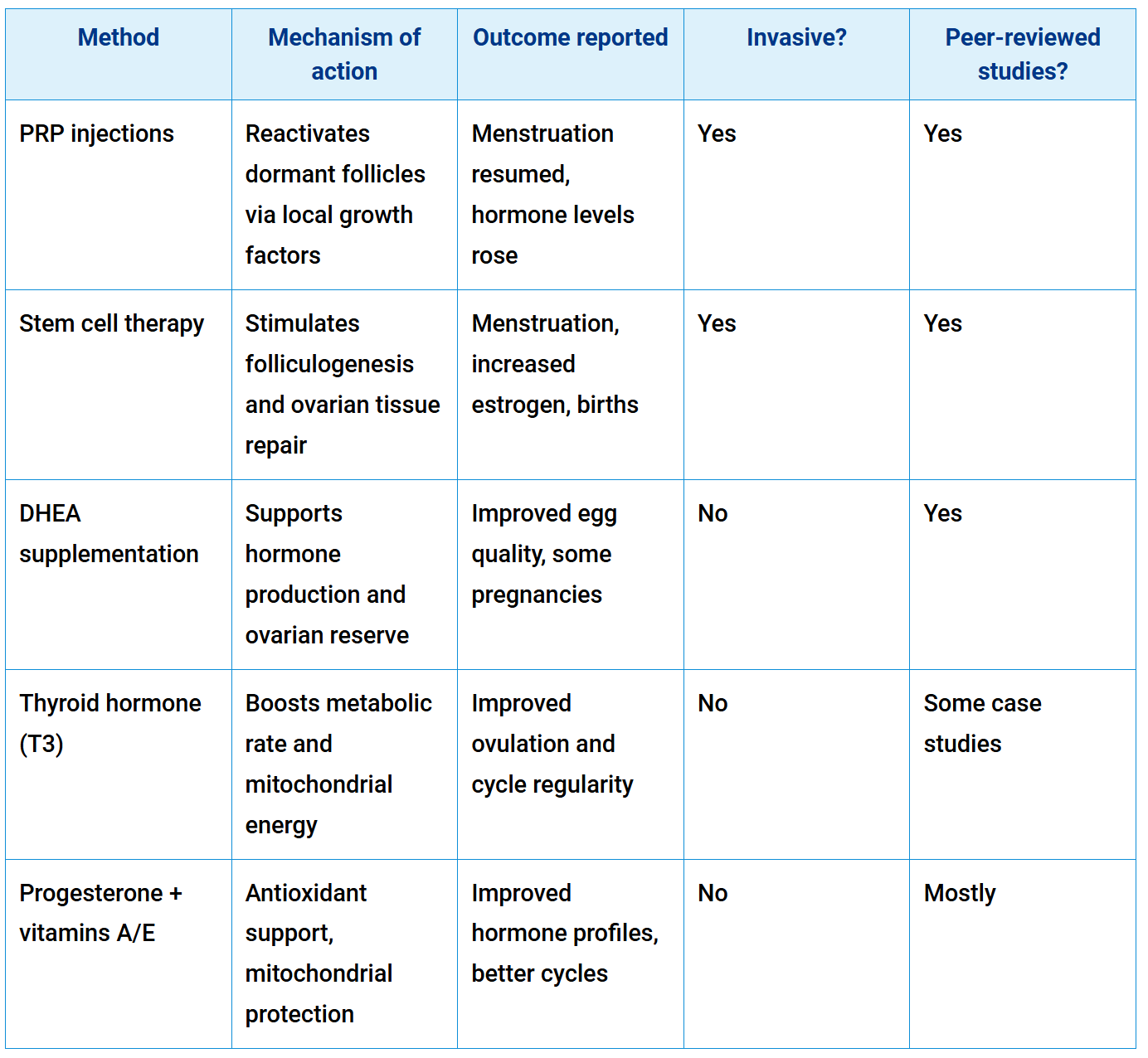
There’s a growing list of experimental approaches aimed at reversing menopause or reactivating ovarian function. Some rely on cutting-edge biotechnology, while others use common metabolic supportive techniques that have been around for decades. Their goal is the same: to restart ovarian hormone production and follicle activity by fixing the underlying metabolic dysfunction.8
Intraovarian platelet-rich plasma (PRP) therapy — One of the most talked-about approaches today, this method uses a person’s own blood, spun down to isolate platelets, which are then injected directly into the ovaries. There are published case studies where PRP has restarted menstrual cycles in postmenopausal women and improved hormonal markers like estrogen and anti-Müllerian hormone (AMH).9 Some even went on to conceive naturally or with IVF.
Stem cell therapy — As mentioned in the previous section, there’s research showing success in using stem cells in women diagnosed with POI. Preclinical studies indicate MSCs may help restore ovarian tissue function by promoting follicle survival and growth, improving hormone production, reducing inflammation, and facilitating tissue regeneration via paracrine signaling and immunomodulation.10
Metabolic therapies are drawing renewed attention as well — Peat was among the first to propose that nutrients like vitamins A and E and hormones like bioidentical progesterone and dehydroepiandrosterone (DHEA) could support ovarian function by restoring mitochondrial energy production.11 These compounds don’t just “balance hormones.” They work upstream — at the level of cellular energy — to support steroid hormone production, follicle maturation, and regular ovulation.
Below is a comparison table outlining the top experimental and metabolic approaches currently used:
What Role Does Mitochondrial Health Play in Menopause and Fertility?
Everything in the body that requires energy — thinking, breathing, digesting, and reproducing — depends on the mitochondria. These are the cells’ microscopic power plants. And when it comes to the ovaries, their role is even more central.
The female eggs are the most mitochondria-rich cells in the entire body — Each one contains over 100,000 mitochondria — more than any muscle or brain cell.12 Why? Because ovulation, fertilization, and early embryo development demand massive amounts of energy. That means if mitochondrial function starts to falter, even slightly, ovarian performance takes a hit.
Mitochondrial DNA in most body tissues accumulates mutations with age — But as the featured study showed, egg cells don’t follow this pattern. In fact, their mitochondrial DNA remains relatively stable over time, suggesting that they have a built-in protective system. So if menopause occurs despite this mitochondrial stability, it points to a different issue: The overall energy metabolism, not the eggs themselves, is impaired.
This theory is gaining traction among researchers — Mitochondrial dysfunction appears in both the ovaries and surrounding follicular cells before menopause symptoms even emerge. This dysfunction affects adenosine triphosphate (ATP) production, the cells’ energy currency, increases oxidative stress, and lowers the output of hormones like estrogen and progesterone.13
In other words, the body starts slowing down hormone production — not because the eggs are gone, but because they’re energy-starved.
Now, here’s where it gets even more compelling — When mitochondrial function is supported or restored, ovarian function can return. One study showed that using DHEA increased mitochondrial density and ATP output in ovarian cells, improving egg quality and hormonal balance.14 Meanwhile, thyroid hormone (particularly T3) has been shown to boost mitochondrial biogenesis, directly increasing the energy output of cells in the ovaries.15
What to Do to Support Ovarian Energy and Reverse Menopause Symptoms
If menopause is driven by a loss of energy, not a loss of eggs, then restoring cellular power becomes the most effective strategy. Restoring ovarian metabolism can be done using simple, evidence-based steps that support mitochondrial function.
Start with the foundations — Thyroid health, healthy carbohydrate intake, and mitochondrial nutrients are non-negotiables. Thyroid hormones regulate metabolic rate and mitochondrial output, and having low T3 levels, which is common in perimenopausal and postmenopausal women, leads to a drop in cellular energy production.
That includes the cells inside the ovaries. Supporting the thyroid with enough bioavailable protein, carbs, and minerals (like magnesium and selenium) helps restore that energy.
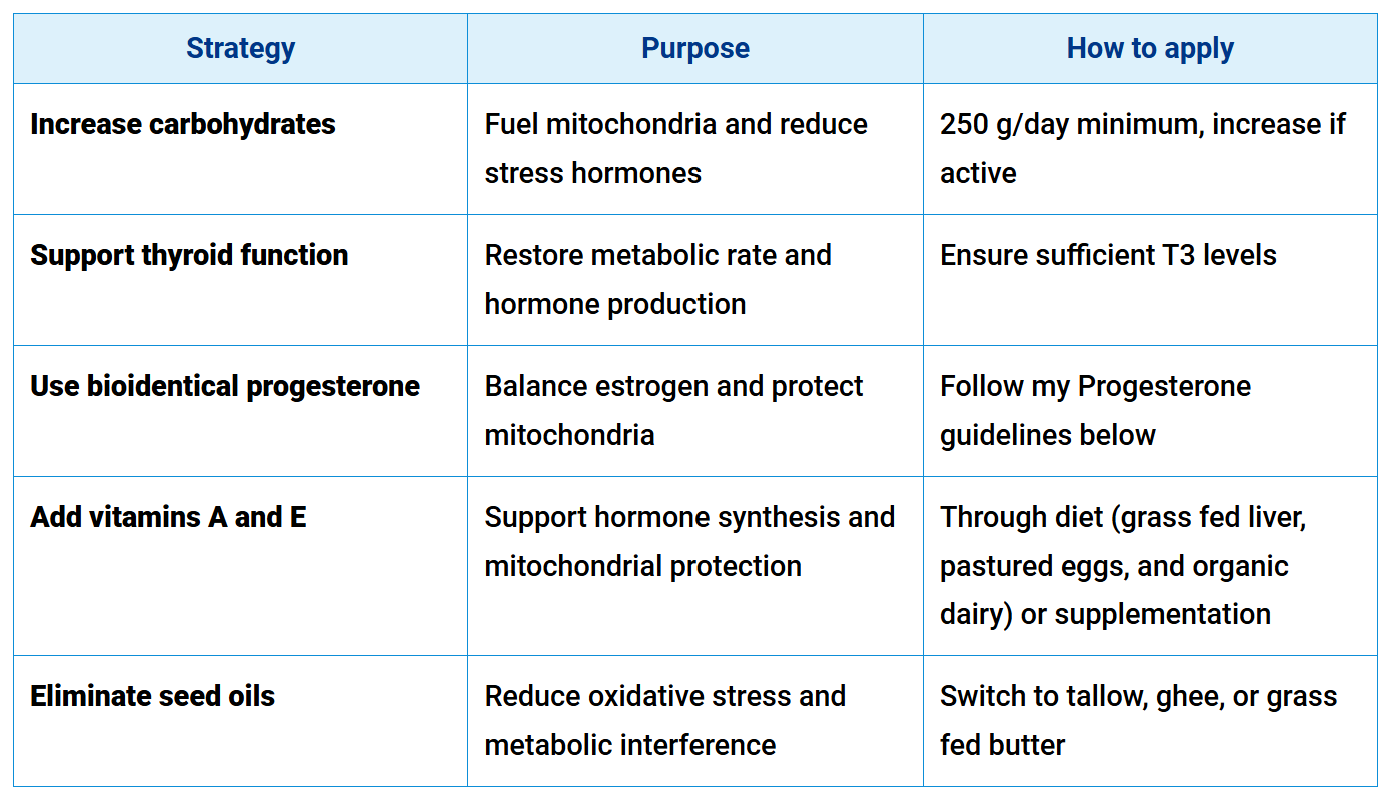
Focus on healthy carbohydrates — Carbs are the most efficient fuel for the mitochondria, and most adults need at least 250 grams per day. Without them, the body shifts to fat oxidation, a backup system that creates more stress, not more energy. As Peat emphasized for decades, restoring ovarian function requires sugar metabolism — not starvation.
Consider bioidentical progesterone (not synthetic progestins) — Progesterone plays a direct role in regulating the menstrual cycle, protecting brain and bone health, and calming the stress response. However, it also promotes mitochondrial respiration and supports thyroid hormone conversion. This makes it a central player in menopause reversal.
For women with signs of estrogen dominance, like heavy periods, breast tenderness, anxiety, or insomnia, adding progesterone under a practitioner’s guidance can restore balance and stimulate ovulatory function. My recommended strategy to administer progesterone is found at the end of this article.
Vitamins A and E are another overlooked necessity — Vitamin A is required for steroid hormone production, follicular development, and thyroid receptor sensitivity.16 Many women unknowingly live with subclinical vitamin A deficiency, especially those avoiding liver, eggs, and dairy. When vitamin A intake is optimized, hormone output improves, including progesterone.
Meanwhile vitamin E protects ovarian tissue from oxidative stress, a key driver of mitochondrial breakdown.17 It helps improve mitochondrial respiration, reduce follicular apoptosis (cell death), and improve ovarian reserve markers. It also protects against lipid peroxidation in polyunsaturated fat-rich environments — something nearly every modern woman is exposed to due to the ubiquity of seed oils.18
To summarize, here’s the recommended protocol:
How to Use Progesterone
Before you consider using progesterone, it is important to understand that it is not a magic bullet, and that you get the most benefit by implementing a Bioenergetic diet approach that allows you to effectively burn glucose as your primary fuel without backing up electrons in your mitochondria that reduces your energy production. My new book, “Your Guide to Cellular Health: Unlocking the Science of Longevity and Joy,” covers this process in great detail.
Once you have dialed in your diet, an effective strategy that can help counteract estrogen excess is to take transmucosal progesterone (i.e., applied to your gums, not oral or transdermal), which is a natural estrogen antagonist. Progesterone is one of only three hormones I believe many adults can benefit from. (The other two are DHEA and pregnenolone.)
I do not recommend transdermal progesterone, as your skin expresses high levels of 5-alpha reductase enzyme, which causes a significant portion of the progesterone you’re taking to be irreversibly converted primarily into allopregnanolone and cannot be converted back into progesterone.
Ideal Way to Administer Progesterone
Please note that when progesterone is used transmucosally on your gums as I advise, the FDA believes that somehow converts it into a drug and prohibits any company from advising that on its label. This is why companies promote their progesterone products as “topical.”
However, please understand that it is perfectly legal for any physician to recommend an off-label indication for a drug to their patient. In this case, progesterone is a natural hormone and not a drug and is very safe even in high doses. This is unlike synthetic progesterone called progestins that are used by drug companies, but frequently, and incorrectly, referred.
Dr. Ray Peat has done the seminal work in progesterone and probably was the world’s greatest expert on progesterone. He wrote his Ph.D. on estrogen in 1982 and spent most of his professional career documenting the need to counteract the dangers of excess estrogen with low-LA diets and transmucosal progesterone supplementation.
He determined that most solvents do not dissolve progesterone well and discovered that vitamin E is the best solvent to optimally provide progesterone in your tissue. Vitamin E also protects you against damage from LA. You just need to be very careful about which vitamin E you use as most supplemental vitamin E on the market is worse than worthless and will cause you harm not benefit.
It is imperative to avoid using any synthetic vitamin E (alpha tocopherol acetate — the acetate indicates that it’s synthetic). Natural vitamin E will be labeled “d alpha tocopherol.” This is the pure D isomer, which is what your body can use.
There are also other vitamin E isomers, and you want the complete spectrum of tocopherols and tocotrienols, specifically the beta, gamma, and delta types, in the effective D isomer. As an example of an ideal vitamin E, you can look at the label on our vitamin E in our store. You can use any brand that has a similar label.
You can purchase pharmaceutical grade bioidentical progesterone as Progesterone Powder, Bioidentical Micronized Powder, 10 grams for about $40 on many online stores like Amazon. That is nearly a year’s supply, depending on the dose you choose.
However, you will need to purchase some small stainless steel measuring spoons as you will need a 1/64 tsp, which is 25 mg and a 1/32 tsp, which is 50 mg. A normal dose is typically 25 to 50 mg and is taken 30 to 60 minutes before bed, as it has an anti-cortisol function and will increase GABA levels for a good night’s sleep.
If you are a menstruating woman, you should take the progesterone during the luteal phase or the last half of your cycle, which can be determined by starting 10 days after the first day of your period and stopping the progesterone when your period starts.
If you are a male or non-menstruating woman, you can take the progesterone every day for four to six months and then cycle off for one week. The best time of day to take progesterone is 30 to 60 minutes before bed as it has an anti-cortisol function and will increase GABA levels for a good night’s sleep.
This is what I have been personally doing for over a year with very good results. I am a physician so do not have any problems doing this. If you aren’t a physician, you should consult one before using this therapy, as transmucosal progesterone therapy requires a doctor’s prescription.
Frequently Asked Questions (FAQs) About Reversing Menopause
Q: Is menopause really just a sign of running out of eggs?
A: The traditional view holds that menopause marks the end of ovarian reserve — you simply run out of viable eggs. But research is shifting toward a bioenergetic explanation: Ovarian failure isn’t caused by egg depletion, but by mitochondrial dysfunction.
Q: Can menopause be reversed?
A: Emerging evidence suggests that menopause, long considered a permanent shutdown of ovarian function, may instead be a reversible metabolic state. New research from Penn State University found that human egg cells (oocytes) do not accumulate mitochondrial DNA mutations with age, unlike other tissues. This challenges the idea that menopause is irreversible due to egg depletion.
Experimental therapies like platelet-rich plasma (PRP) injections and stem cell transplantation have helped some women with premature ovarian insufficiency (POI) resume menstruation and, in some cases, even conceive. These women had been classified as infertile, yet ovarian function resumed after treatments that restored energy metabolism in the ovaries.
Q: How do mitochondrial DNA mutations relate to ovarian aging?
A: Mitochondria are the power plants of your cells, and the ovaries contain some of the most mitochondria-rich cells in your entire body. Each egg cell has over 100,000 mitochondria, more than brain or muscle cells, because reproduction demands enormous energy.
The featured study revealed that while mitochondrial DNA (mtDNA) in blood and saliva accumulates mutations with age, mtDNA in egg cells remains stable — even in women over 40. This suggests the ovaries may have natural defense mechanisms that protect their energy-producing machinery. Supporting mitochondria could therefore help reverse menopausal changes.
Q: Is PRP effective for “ovarian rejuvenation”?
A: Platelet-rich plasma (PRP) shows promise in the emerging field of ovarian rejuvenation. In one 2021 study published in Menopause, researchers injected PRP combined with follicle-stimulating hormone (FSH) directly into the ovaries of women with early menopause. Eleven out of 12 patients resumed menstruation, and one became pregnant shortly afterward.
PRP is still experimental and not yet mainstream, but several clinics are beginning to offer it as part of regenerative gynecology programs.
Q: Where should I start if I’m curious about emerging options?
A: If you’re a woman who’s exploring ways to reverse menopause symptoms or support your ovarian health, start by restoring mitochondrial energy production. Follow these five foundational steps:
Increase carbohydrate intake — Aim for at least 250 grams per day to fuel mitochondria and lower stress hormones.
Support thyroid function — Optimize T3 levels and support your thyroid with magnesium, selenium, and bioavailable protein.
Use bioidentical progesterone — Supports thyroid, protects mitochondria, and balances estrogen.
Add vitamins A and E — These vitamins aid hormone production and defend ovarian cells from oxidative stress.
Eliminate seed oils — Replace them with tallow, ghee, or grass fed butter to reduce mitochondrial damage.
You can also explore supervised therapies like bioidentical hormone replacement, PRP injections, or stem cell therapy, depending on your health status and access to qualified practitioners.
Before beginning any intervention, it would be wise to work with a practitioner trained in bioenergetic or functional medicine, who can evaluate your metabolic function, thyroid status, and hormonal patterns.
Disclaimer: The entire contents of this website are based upon the opinions of Dr. Mercola, unless otherwise noted. Individual articles are based upon the opinions of the respective author, who retains copyright as marked.
The information on this website is not intended to replace a one-on-one relationship with a qualified health care professional and is not intended as medical advice. It is intended as a sharing of knowledge and information from the research and experience of Dr. Mercola and his community. Dr. Mercola encourages you to make your own health care decisions based upon your research and in partnership with a qualified health care professional. The subscription fee being requested is for access to the articles and information posted on this site, and is not being paid for any individual medical advice.
If you are pregnant, nursing, taking medication, or have a medical condition, consult your health care professional before using products based on this content.